
PRAGMATA (2026) ~ The Most Wholesome-Hearted Shoot-Em-Up
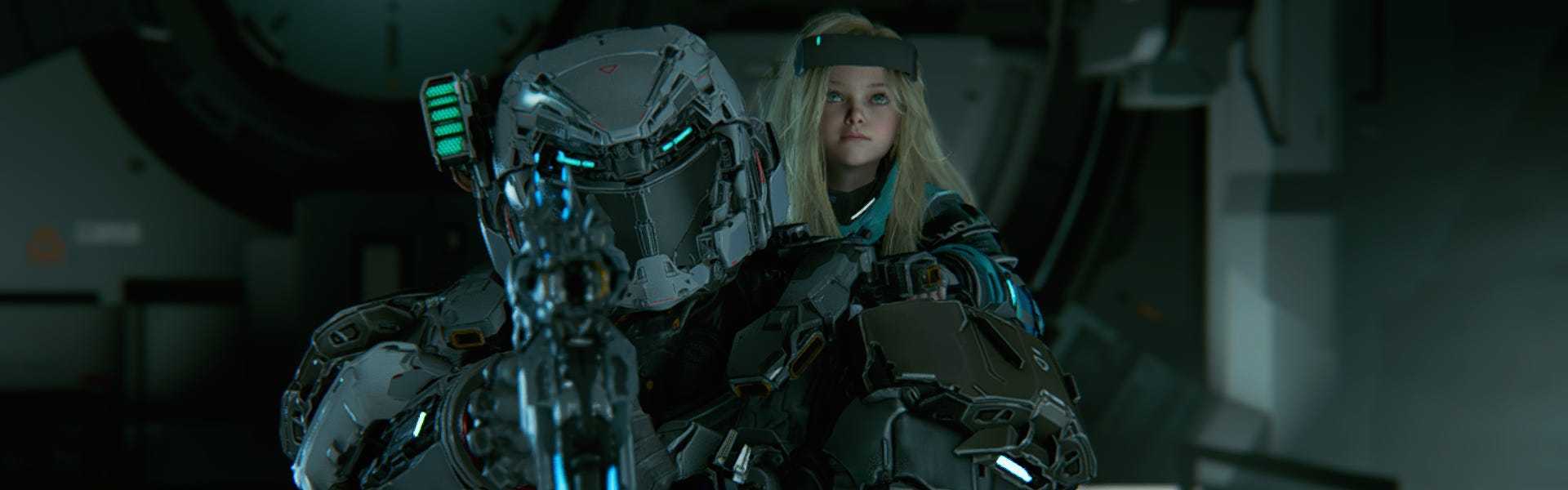
As I’ve said before, Pragmata is the AAA game I’ve anticipated the most for years, first catching my eye with its vague and bizarre announcement trailer released six years ago. Even its very title builds intrigue, because…
Well, what the heck does “pragmata” even mean?!
It’s amusing to see many of the comments on that trailer comparing it to Hideo Kojima—the madman behind Metal Gear Solid and Death Stranding who cinematically revolutionized video game storytelling with the former—because the finished product isn’t nearly as bizarre as that first ever impression let on, especially not in a zany Kojima way.
It’s actually concept artist Yonghee Cho in his first time directing, after all.
The story brings us to a high-tech base on the moon—the Cradle—as system auditor Hugh Williams, who’s sent with a team to investigate why Earth has lost contact with the Cradle. There, we find out that the base’s AI system IDUS has gone rogue and killed all the humans, with hostile robots under its control.
We also find a highly advanced android—the titular pragmata—designed to look like a precious little girl who we nickname Diana, and she just might be the most endearing video game companion I’ve ever known!
As she rides on our back and hacks into the Cradle’s systems, including the robots’ outer armor so that we can deal them real damage, she’s as much the player character as Hugh is. Having to hack into every robot also adds an element of strategy to every encounter, and the shooting mechanics feel like an evolution of what its own developer Capcom started in Resident Evil 4, except here—thankfully—we can actually move while aiming!
And yet, for as challenging as the combat is, only a couple of optional bonus challenges killed me, so I essentially didn’t die at all! Had close calls, though.
The Cradle gives us a shelter to return to in between the action where we can upgrade our gear, costumes, and hacking nodes; build Diana set pieces of Earth activities to give her a taste of the planet; complete those aforementioned bonus challenges for extra currency; and even have additional conversations with Diana. Given how deeply it lets us build our dynamic with her, it must count for something that she’s making many players want kids of their own!
The pairing of the two leads makes for a compelling dichotomy of young optimism and experienced realism, with each one’s outlook shown most clearly in what each anticipates will be the fate of a third party (whose surprise presence I’m disappointed to learn was revealed in a trailer just before release).
The concept of a humanlike android does raise the story’s most ambiguous moral questions. How ethical is it to create machines in our image, including in the image of a specific person, as we learn is the case within the game’s universe? Would such a machine gain a rational soul? I don’t think it would in reality, but Hugh does, and I can accept such a concept in a work of fiction.
There are even trees in the Cradle made of special metal being mined from the moon—lunafilament—that function like real trees. Would we be essentially playing God by recreating the world through technology?
Despite these uneasy questions, the father-daughter dynamic at the heart of the story as well as only a dash of vulgarity make this arguably the most wholesome AAA game in years that’s not explicitly aimed at family audiences, especially when all the enemies are just robots!—even if many of them look freaky. (Of course, Lord of the Rings is plenty freaky and still very wholesome.)
Beating the game unlocks multiple replay modes, including a new game plus that carries over all your upgrades to the story’s beginning. Though I have yet to play them, it’s still safe to say that, between this and Planet of Lana II, that’s two for two of my anticipated games this year living up to the hype!
★★★★
Teens+
I’m also on Letterboxd, Backloggd, and Buy Me a Coffee